Brief description of the project
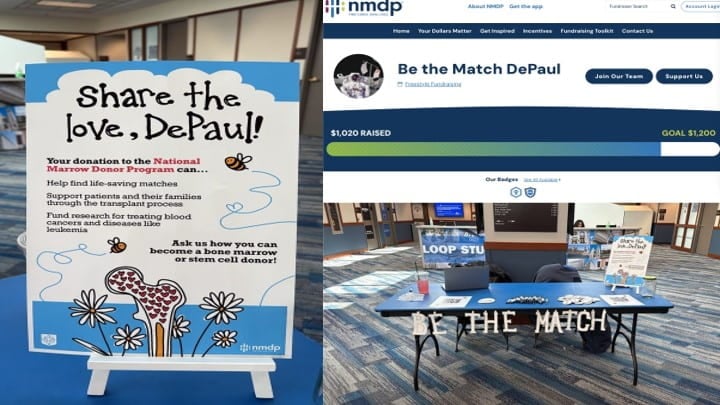
To support the National Marrow Donor Program (NMDP), our team held a three-week fundraising campaign to generate donations, encourage donor sign up, and raise awareness. Our fundraiser concluded with a designated, “Be the Match Day DePaul” on Wednesday, March 12th, from 11am to 1pm. On Be the Match Day, our team hosted a promotional table on the DePaul Loop campus to spread awareness about the life-saving impact of marrow and blood stem cell donations, to educate participants about the process of donating, and to encourage them to join the registry and/or donate funds to the organization. During the event we handed out merchandise that was provided to us by National Marrow Donor Program.
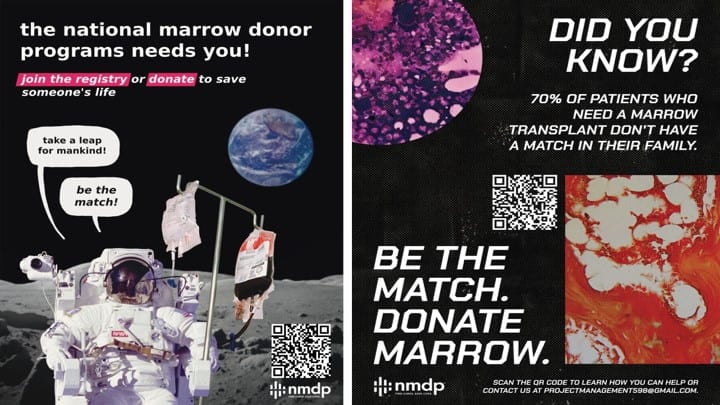
Over the weeks leading up to Be the Match Day, the team ran social media initiatives on several platforms and posted flyers to maximize engagement. These social media initiatives involved frequent posts made by team members, including informational blurbs, inspiring stories found online, and reminders to join the registry or donate. Viewers were encouraged to scan the QR code which directed them to the team’s personal fundraising page made through NMDP’s website. Our goal was to use this structured campaign to raise funds, register new donors, and support the mission of NMDP effectively through online and in-person efforts.
Brief description of the charity
The National Marrow Donor Program, previously known as Be the Match, is a nonprofit organization which NMDP facilitates transplants of peripheral blood stem cells (PBSC) and bone marrow for patients with life- threatening blood cancers and disorders. Founded in 1987 in Minneapolis, MN, the organization has an international reach and operates the world’s largest, most diverse donor registry. NMDP also funds research programs and supports families through the transplant process. They have a strong social media presence, with active pages on Facebook, Threads, LinkedIn, and Instagram (@nmdp_org), where they post regularly to 168,000 followers. On their website, NMDP offers extensive material on other ways to get involved, like fundraising and various methods of raising awareness.
Contact information:
– Primary contact: Evan Hutton
– Website: https://bethematch.org
– Toll-free phone: 1 (800) MARROW-2
Factual analysis of success in terms of project objectives
Our team created a donation website through the National Marrow Donor Program that kept track in real-time of our progress towards meeting our goal of raising $1200. We implemented a worst, most likely, and best-case scenario to help us evaluate & track the progress of our donation goal of $1,200. Our team completed the project with $1,020 raised and fell just $180 short of our goal. We had a total of thirteen donations that averaged around $40 each, and our highest donation was for $500.
- Best Case: $1,500 raised through online donations.
- Most Likely: $1,200 raised donations.
- Worst Case: Less than $500 raised.
Our team also set a goal to confirm twenty-five registered donors, but we were not able to confirm any donors to register (Due to NMDP training unavailability until March 10th). We also set a goal to distribute all merchandise that was provided to us by NMDP, during our “Be the Match DePaul” event. However, we only had two guests visit our promotion table.
Two or three lessons learned about managing projects
One of the lessons learned about managing projects relates to gathering information and planning early. After a couple of weeks into the project, we discovered that there was not any availability to meet with an NMDP staff member for training until March 10th. Without the training we were unable to recruit bone marrow donors. Another lesson we learned about project management is the importance of being able to adapt. Our team had to adapt and adjusted our advertising approach to strictly fundraising and spreading awareness when we found out we could not recruit bone marrow donors. If we knew this information to begin with, we would have abandoned recruitment strategies immediately and focused on fundraising and spreading awareness, which could have added an extra two weeks of fundraising time to the project.
Advice for future teams doing similar projects
- Complete the research early, create the project scope, and start planning. Proper research can make a significant difference in reducing scope creep.
- Establish a communication plan that works for all team members and maintain transparency.
- Create a SharePoint folder to store all documents so they can easily be referenced by any team member. We also utilized the “Group Me” app for discussions outside of our Zoom meetings.
- Assess all risks (major & minor) to the project, be flexible and adapt to the project as needed, and create contingency plans to combat risks.
- Support each other& have fun!
Photos related to the project.